


England Golf did not hand out a single slow play penalty in any of their 2024 championships following the trial of checkpoints.
The radical approach to speeding up the game, which saw groups timed at various points of their round, has now been adopted full-time after proving a huge success.
Introduced ahead of the English Senior Women’s Amateur Championship at York last May, golfers had to hit specified round times following the 4th, 9th and 14th holes of their rounds.
The governing body brought in the checkpoints to shift the responsibility for keeping the game moving from rules officials back towards players.
Enforced through a Local Rule, groups were considered to have missed a checkpoint if they arrived at a Pace of Play checkpoint after the time allowed for the number of holes completed.
Issued a warning at first, a second missed checkpoint would bring a one stroke penalty, while a third would see every player handed an additional two stroke sanction.
Asked how the policy had performed ahead of the start of this season’s competition calendar, James Crampton, England Golf’s director of championships, said: “We had a bit of debate in the office as to how many penalties we would give out and I think I said, ‘It wouldn’t surprise me if we didn’t give any’ because I really couldn’t get my head around why a group wouldn’t do something about their pace of play if they knew they wouldn’t make the checkpoint.
“We had a few very close situations where penalties could have been applied but, within the policy, there were examples of various circumstances where one wouldn’t be given out and a few groups were fortunate to fall under those categories.
“So we actually didn’t impose any penalties, but we had a quite high-profile group in the English Amateur running down the fairway to make their checkpoint.”
Advertisement
Crampton said rulings and multiple lost balls could be circumstances where a group who missed a checkpoint might not pick up a penalty and he continued: “Things like not playing a provisional wouldn’t fall under that category, because that’s part of the education around managing yourself properly.
“But there are situations where a group has missed the first checkpoint, they are in danger of missing the second, they’ve got themselves back into position and up with the group in front, and then the hole before the checkpoint they’ve had a five-minute ruling and ended up missing it.
“Because they’ve made every effort to get back into position, the penalty is not applied.”
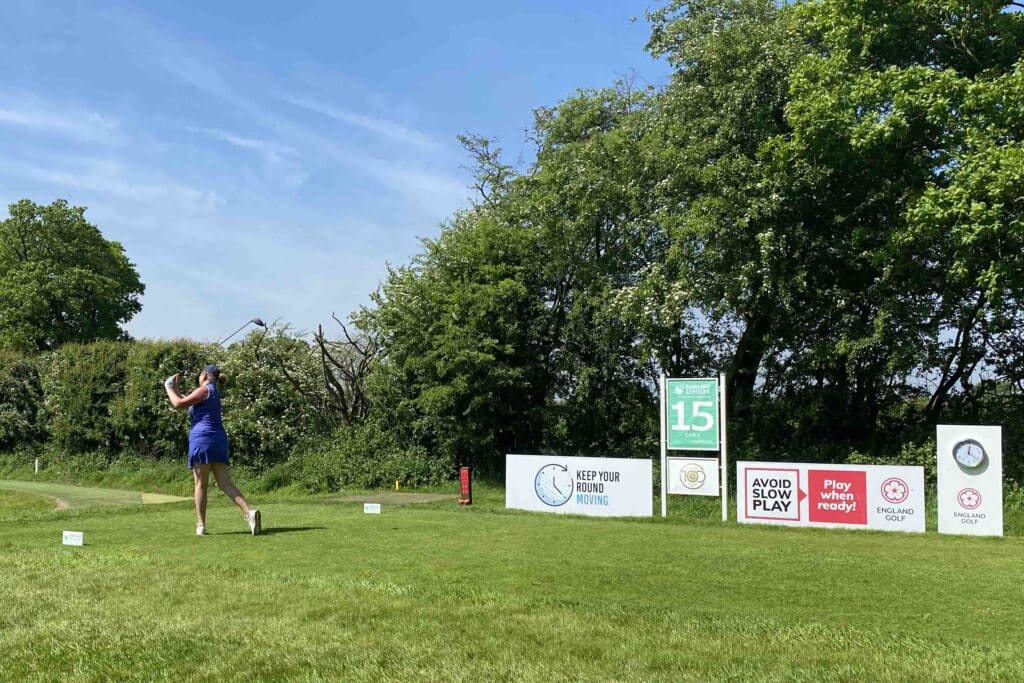
Could the pace of play checkpoints policy work at your club?
Evaluating the policy, he said: “What we tended to find was players, collectively as a group, really made a good attempt to get themselves back into position.
“As long as they’re not that far out, picking up five or six minutes over the space of five or six holes should be a relatively easy thing to do.
“The intention of this policy was never for us to give out penalty strokes and we’re not going around looking at applying penalty strokes to players because they’re not meeting checkpoints.
“We’ve been mindful of how we created our round times and we do take into account the difficulty of the golf course, the field size, and various other things.”
England Golf will now look at how the policy could be used in some of their handicap events over the next couple of seasons. Asked whether a version of the scheme could be implemented by clubs in their big championships, Crampton said: “The challenge for golf clubs is personnel on the course.
“We started last season with the idea that we wouldn’t need as many referees on the course to manage this policy and, as we went through, we found we probably did need an extra referee.
“We’ve put that person back into this year’s schedule – so we’ve got the ability to speak to golfers who have missed checkpoints rather than that being done by a volunteer.
“I think the challenge for golf clubs that wish to impose a policy is getting people on the course who can manage and monitor pace of play because that’s hugely important.
“You can’t just say, ‘you have to meet checkpoints’ and we need to think about our guidance to clubs in creating a club version of this.
“But this is an opportunity where clubs could look at their bigger competitions and say, ‘we need two or three people on the golf course who manage these times and are in a position to waive penalties if there are circumstances that don’t justify one being awarded’.
“I think I saw somewhere a club had said, ‘you have to be at these points at these times and, if you’re not’, you’re going to get a penalty.
“I think that’s dangerous but if there is a bespoke system we do that allows a club to implement it then I don’t see any reason why it couldn’t be used at club level.
“It just makes players a bit more aware of their pace of play.”
Now have your say
Advertisement